Detection technology
Underground Leak Detection Technology
No single instrument suits every underground pipeline. We first review the pipe, route, pressure, access, surface and surrounding noise, then choose the checks that fit the site.
We compare readings from several locations before marking the most likely leak area.

The method depends on the pipeline and site
Metal and plastic pipes carry sound differently. Depth, pressure, soil, paving, traffic, machinery, pumps and access also affect what can be checked.
Route drawings, pipe material, diameter, depth and pressure help us select useful listening and comparison points. A single reading is never used on its own.

Review, compare and narrow the area
- Review — Check the water source, pipe route, material, diameter, pressure, valves and available drawings.
- Assess — Consider the reported problem, meter or pressure readings, site noise and access.
- Select — Choose the acoustic or system checks that fit the site.
- Compare — Check several locations and look for a repeatable change along the route.
- Mark and explain — Mark the suspected area when the readings support it and explain the next step.

Compare sound along the suspected route
Water escaping from a pressurised pipe may create vibration that travels through the pipe, ground or surface. A ground microphone helps the technician compare accessible points along the route.
Traffic, machinery, pumps and flowing drains can interfere, so quieter inspection periods may be useful.
- Ground listening is carried out progressively across suitable points along the suspected pipeline route.
- Mikron 3 listening equipment prepared for field investigation.
- A control-unit display is supporting evidence and is not presented as proof of a leak.

Check accessible valves, fittings and pipework
Listening sticks and contact sensors can compare vibration at valves, hydrants, meters, fittings or exposed pipework. A louder point is not automatically the leak location; distance, pipe material, fittings and connected machinery can change what is heard.

Compare recordings between two contact points
Wireless loggers record vibration at two accessible points. When the route, pipe material, distance and signal conditions are clear enough, correlation can help estimate where a consistent noise source lies between them.
Branches, mixed pipe materials, incorrect route information, weak signals and changing background noise can affect the result. The correlation result is checked against the site.
- Enigma loggers, the field case and laptop prepared for wireless noise-correlation work.
- A wireless noise logger is checked and prepared before field deployment.
- A logger attached to an accessible hydrant for field recording.
- Logger data is reviewed alongside pipeline information and field observations.


Use pressure and pump readings to guide the search
Pressure loss and jockey-pump cycling can help show how a system is changing and which section should be checked next. These readings do not identify the underground location by themselves.
Any shutdown or operating change must be agreed with the responsible site team.
- Pressure observation supports assessment of system behaviour; it does not identify an exact underground location.
- Pump-room conditions provide operating context before field investigation.


Compare separate parts of a network
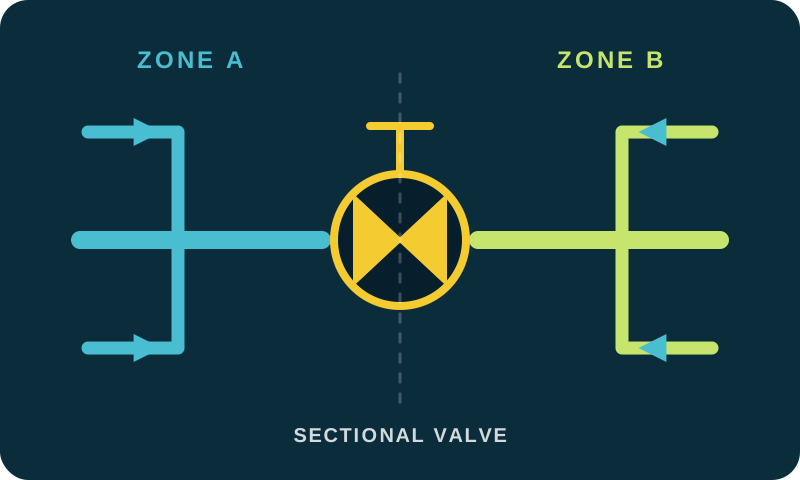
Where valves and operations allow, sections may be isolated and compared. This can reduce a large network to a smaller area before detailed listening begins.
The method depends on reliable valves, safe operating procedures and enough time to observe each section.
Check whether unexplained water movement continues
At apartments, factories and shared systems, a main meter can show whether water continues to move after known use has been stopped where practical. It does not show where the underground problem is.

Pipe material changes what can be heard
- Metal pipes may carry leak sound over useful distances, although joints, branches and noise still affect it.
- Plastic pipes often carry weaker sound and may need closer listening points.
- Long or branched routes may need sectional comparison first.
- Deep or low-pressure pipes may produce limited sound.
- Noisy sites may need a quieter inspection period.
Compare before marking
We compare nearby points, the route and the available meter, pressure or pump readings before marking a suspected location. If the readings remain unclear, we explain the limitation instead of forcing a conclusion.

Detection narrows the area before the ground is opened
The appointed contractor normally excavates and repairs the pipe. The actual crack, failed joint or other condition can only be confirmed after the relevant section is exposed.
- Controlled excavation at the investigated area to expose the relevant pipeline section.
- Tree roots and complex ground conditions can affect access during excavation.


What can make detection more difficult
Very small leaks, plastic pipe, low pressure, deep burial, incomplete drawings, traffic, machinery, pumps, complex ground and more than one leak can reduce the clarity of the readings.
No method can guarantee a result in every situation. We explain what was found, what affected the work and the most practical next step.
Tell us about the pipeline system.
Share the route, pipe information, meter or pump readings and site conditions you already know. We will explain what else is needed before planning the inspection.
Request an Assessment